

share to:


Video by Zhao Chenxiao
The APEC Study Centers Consortium Youth Scholars Forum, the first academic forum in the APEC history dedicated specifically to young scholars, opened Thursday at The Chinese University of Hong Kong, Shenzhen (CUHK-Shenzhen) in Longgang District.

Caitlin Pienaar from Australia speaks to Shenzhen Daily reporters while attending the APEC Study Centers Consortium Youth Scholars Forum, which opened Thursday at The Chinese University of Hong Kong, Shenzhen (CUHK-Shenzhen) in Longgang District. Courtesy of the forum organizers
The gathering brought together more than 800 scholars and representatives from 13 APEC economies — including Australia, Chile, South Korea, Malaysia, Mexico, New Zealand, Peru, and Singapore — to explore critical themes of youth empowerment and innovation-led growth.
Held from May 7 to 8 under the theme “Shaping New Drivers of Development: Youth, Innovation, and a Sustainable Future,” the event has also been included in the official “APEC China 2026” program.
It's the first time that youth voices were brought onto the academic stage of regional cooperation in a dedicated and systematic way under the APEC framework.

Participants chat during a tour of CUHK-Shenzhen. Photos courtesy of the event organizers
The forum brought together emerging scholars and policy thinkers from 13 APEC economies to exchange ideas and explore pathways for regional cooperation and sustainable growth.
The event was jointly organized by CUHK-Shenzhen and the APEC Study Center at Nankai University, with support from The Institute for International Affairs, Qianhai.
In his welcome remarks, Xu Yangsheng, president of CUHK-Shenzhen, highlighted Shenzhen’s youthful dynamism.
“With an average age of just 32, Shenzhen is one of the world's youngest major cities. Reflecting this youthful energy, CUHK-Shenzhen is home to more than 1,000 international students from 41 countries and regions. We believe that understanding and innovation flourish when people from different backgrounds learn and work together.”
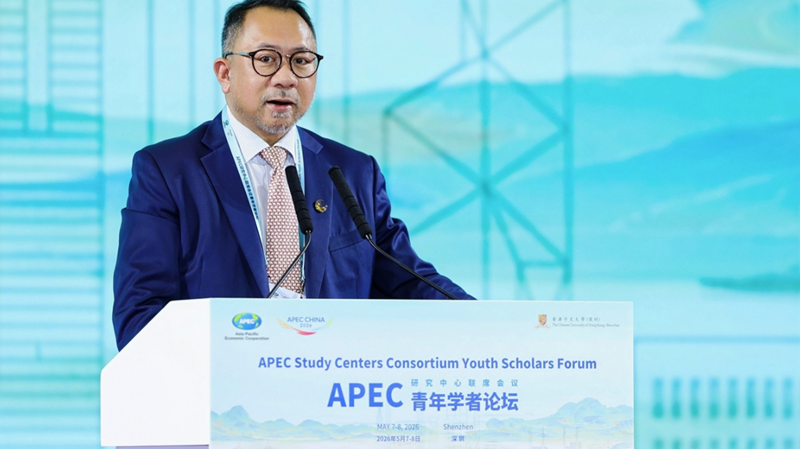
APEC Secretariat Executive Director Eduardo Pedrosa speaks at the opening ceremony.
APEC Secretariat Executive Director Eduardo Pedrosa emphasized that young scholars are “the next wave of innovation and research, bringing fresh momentum to Asia-Pacific cooperation and academic development.”
Reflecting on APEC’s evolution since its founding, Pedrosa noted that the organization has grown from 12 to 21 member economies, now representing 37% of the world’s population and approximately 61% of global gross domestic product. For nearly four decades, APEC has played a pivotal role in advancing trade and economic cooperation across the region.
Following the opening ceremony, the forum moved into four rounds of academic discussions, addressing urgent and forward-looking issues for the Asia-Pacific. Each session explored the shared question: In an increasingly uncertain world, how can the Asia-Pacific cultivate new growth drivers, and how can youth play a more active role in shaping that future?
Young scholars engaged in lively exchanges, offering academic insights, practical proposals, and lessons from their own economies, while identifying new possibilities for cross-regional collaboration.
“It’s a great choice that China has selected Shenzhen as the city to host the main APEC event this year,” said Jose Carlos Feliciano, associate director of the Center for China and Asia-Pacific Studies at Universidad del Pacífico, Peru.“Shenzhen highlights the key aspects that China wants to promote during its presidency.”
“I think APEC can learn the value of innovation from Shenzhen,” added Timothy Richard Lawler, policy and research advisor at the Australian APEC Study Center. “That will be a key takeaway when economic leaders, senior officials, and business leaders visit Shenzhen in November.”


