

share to:


The "Asia-Pacific Youth Gathering: Building a Shared Future Through Energy" event took place Aug 21 in Shenzhen. More than 60 experts, scholars, youth representatives, and journalists from 13 countries and regions, including the Chinese mainland, the Hong Kong Special Administrative Region, Macao, as well as Cambodia, Thailand, Vietnam, Russia, Canada, Australia, and Chile, gathered in the city to explore how young people can contribute to the shared development of the Asia-Pacific region.
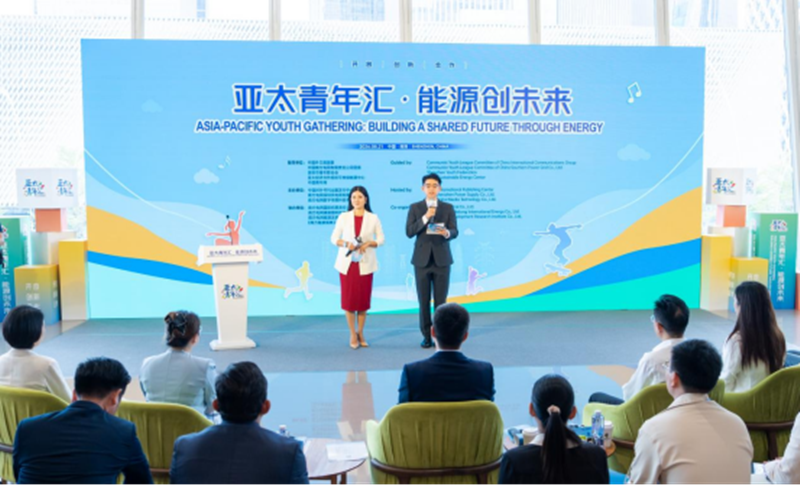
Guests attend the “Asia-Pacific Youth Gathering: Building a Shared Future Through Energy” event. Photos courtesy of Shenzhen Power Supply Bureau
The event was co-hosted by the China International Publishing Center, China Southern Power Grid (CSG) Shenzhen Power Supply, and CSG Digital Media Technology, with support from the Communist Youth League Committee of the China International Communications Group, the Communist Youth League Committee of CSG, the Shenzhen Youth Federation, the APEC Sustainable Energy Center, and Youth.cn.
During the "Story Sharing: Asia-Pacific Youth for Greater Connectivity" session, four youth representatives from different countries and regions shared their personal experiences. Chhoeun Raksmey, director of the Department of Potable Water Policies at the Ministry of Industry, Science, Technology, and Innovation of Cambodia, outlined his country's steady progress toward carbon neutrality.
Wirun Phichaiwongphakdee, director of the Thailand-China Research Center of the Belt and Road Initiative, used vivid cases to illustrate the warmth and tangible benefits of regional cooperation. Alex Choi, co-founder and executive director of MTEL Telecommunications, Macao, China, pointed out that open and interconnected communication infrastructure is the foundation of the digital economy, and that innovation among young people is a key driver of industrial upgrading.
Fan Siran, a customer manager at CSG Shenzhen Power Supply, discussed progress in developing a new power system in the Guangdong-Hong Kong-Macao Greater Bay Area (GBA), citing Shenzhen's "supercharging city" initiative as an example.
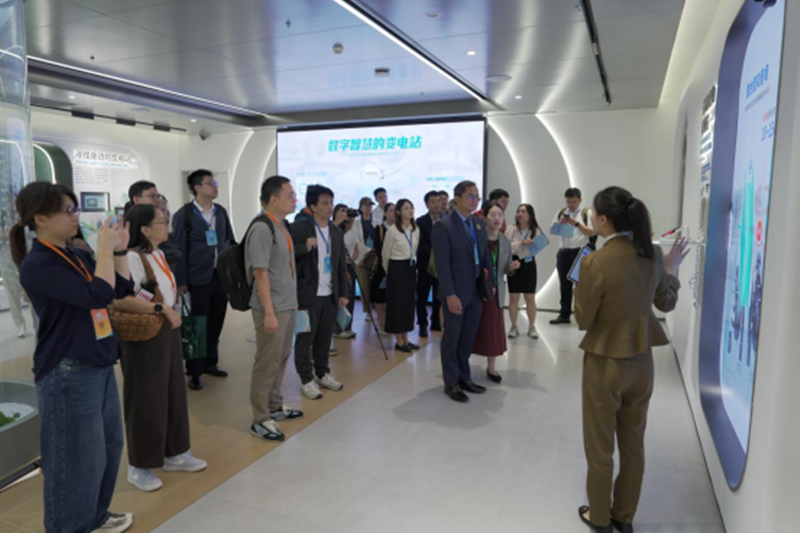
Asia-Pacific youth representatives visit the Chunhui Substation, China's first zero-carbon interactive substation, in Nanshan District.
At the event, youth representatives from multiple countries and regions held in-depth discussions about cross-border energy cooperation, resource complementarity and joint standard-setting.
Indonesia's Antony Hardi proposed that Asia-Pacific energy cooperation should focus on three core pillars — joint connectivity, joint investment, and joint management. Yang Bo, a youth representative from CSG Lancang-Mekong International, showcased the mutual benefits of cross-border energy cooperation through the China-Laos 500-kV interconnection project, noting that grid connectivity is only the first step — enabling electricity to flow freely in the market is the key.
On the topic of electricity-computing synergy and technological innovation, youth representatives shared their perspectives. Wang Hai, an assistant professor at Nanyang Technological University, Singapore, said that competition in computing power is essentially competition in infrastructure capacity, and that the relationship between electricity and computing should shift from one-way supply to two-way synergy.
Li Mengfan, a youth representative from CSG International, suggested building an "electricity plus computing power" support system through regional coordination mechanisms. Russian youth representative Machneva Anna introduced the concept of "financial connectivity," noting that mechanisms such as currency swap agreements can provide buffers for cross-border cooperation, and that the GBA can become a financial support hub for cross-border cooperation. Zhang Qian, a youth representative from CSG Shenzhen Power Supply, said the Greater Bay Area can utilize its advantages in technology, application scenarios and talent to build an AI-plus-energy innovation hub.
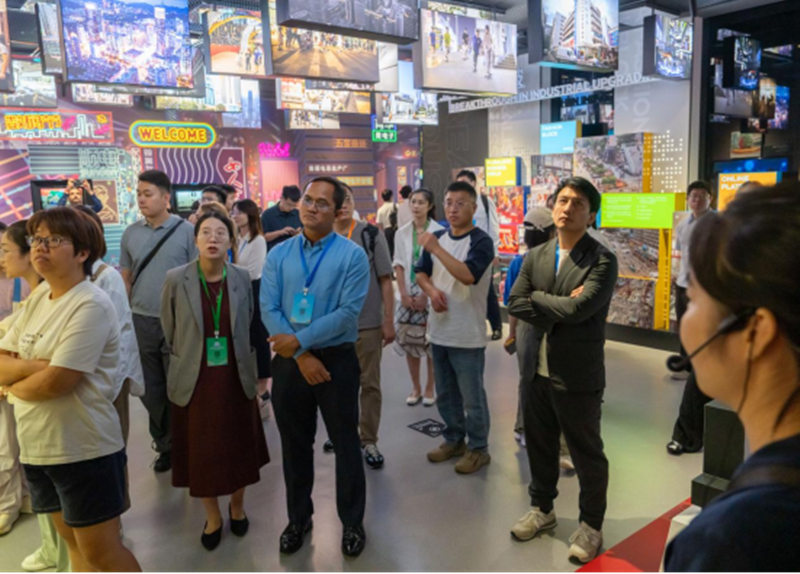
Asia-Pacific youth representatives visit the HQB Museum in Futian.
During the event, the youth representatives also visited the 110 kV Chunhui Substation — the country's first zero-carbon smart educational substation — and the HQB Museum, gaining a deeper appreciation for the city's innovative vitality and development resilience.


